
The Strangers’ Case Premiere
- On April 02, 2026
- By alzand@rice.edu
- In EVENTS, News, Performances
 0
0


Kinetic Ensemble, Musiqa and tenor Karim Sulayman premiered The Strangers’ Case on March 28th. The work was subsequently recorded and filmed for later release.
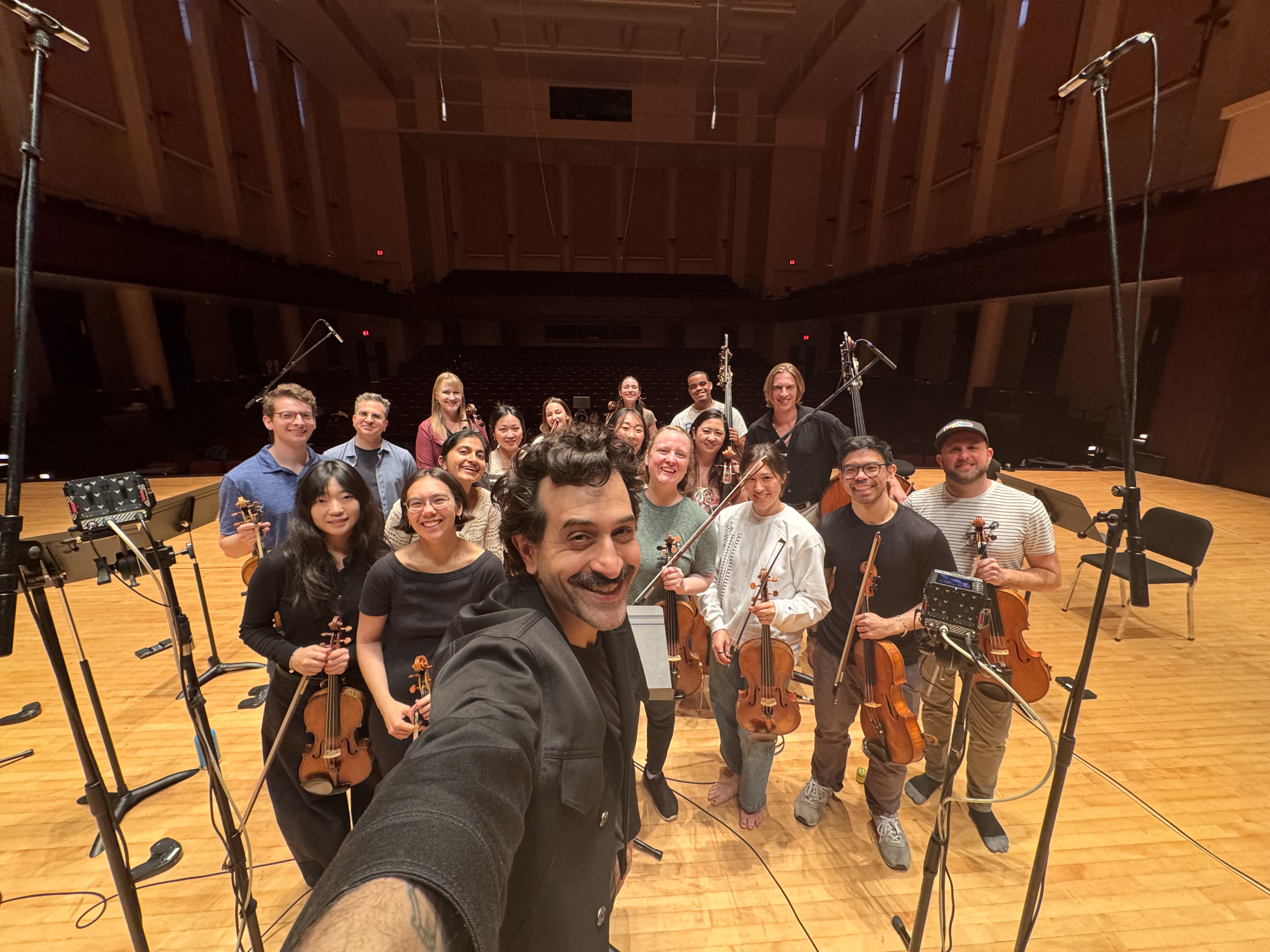
The Strangers’ Case (for tenor and string orchestra) presents songs and chronicles of the immigrant experience. It gathers together poems and narratives from diverse sources about the perennial journey of the “stranger.” The work’s title originates in Shakespeare’s monologue for Sir Thomas More, which eloquently argues for empathy and compassion towards displaced people. The Strangers’ Case reminds us of our shared history, though it is fraught with contradiction, filled with both selfless generosity and selfish indifference.
The Lady in the Harbor uses texts from a unique book, “Life Stories of Undistinguished Americans as Told by Themselves,” a collection of personal, turn-of-the-century accounts by immigrants to the US. It begins with the words of a young Polish girl describing her grueling Atlantic voyage, and concludes with a Syrian refugee’s poetic description of the New York harbor (“Such an Illumination”). Who Can Pity My Loneliness? excerpts a poem written in the wake of the 1882 Asian Exclusion Act. This is one of several anonymous Chinese poems found inscribed on the wooden walls of a San Francisco Bay immigrant detention facility. Whither Would You Go? uses Shakespeare’s monologue for More, in which the Catholic martyr addresses anti-immigrant rioters in 16th century London. The Stranger Within My Gate is a setting of passages from virulently xenophobic poems by Rudyard Kipling (“The Stranger”) and Thomas Bailey Aldrich (“Unguarded Gates”). They Came from Terror and Tumult translates a work by Mexican poet Jaime Torres Bodet (“Éxodo”)  that describes a train of migrants escaping their war-torn homeland. Exile is a melancholic poem by Hart Crane about lovers who are separated by distance. When Dawn Comes to the City is by Claude McKay, a poet of the Harlem Renaissance who immigrated to the US from Jamaica in 1914. The poem contrasts a disaffection for grey, city life with a homesick nostalgia for the Caribbean. A remarkable and prescient 1908 poem by Arthur Upson, The Statue of Liberty (New York Harbor, A.D. 2900), imagines the New York harbor of the far future: the Statue of Liberty is unearthed, sunken in the mire, discovered by a “tyrant who misrules our land.” The piece concludes with Emily Dickinson’s powerful four-line verse, These Strangers, an admonition to friendship and kindness.
It is a truism that the United States is a country founded and strengthened by immigrants. However, current events remind us that this fact slips all too easily from our consciousness. Historically, as now, we have sometimes failed to lift our lamp of welcome. Despite being a foundational part of the American story, newcomers to this country have frequently faced profound mistreatment, exploitation and structural injustice. Nonetheless, the uniquely American immigrant story continues to be an inspirational beacon to the world.
By using texts that span diverse nationalities, stories, voices and historical periods, The Strangers’ Case aims to make a case of its own: though our commitment to immigrants and refugees has been equivocal, nonetheless their success forms the basis of American strength and renewal. As the child of an immigrant, I believe this sort of consciousness-raising is the only way forward. And as an artist, I believe that music is an ideal spark to kindle the altruism in our better natures.
