Strange Machines released by the Balourdet Quartet
- On October 08, 2026
- By alzand@rice.edu
- In Uncategorized
 0
0

On October 2nd, Phenotypic Recordings released a new album from the Balourdet Quartet, Strange Machines, an album that 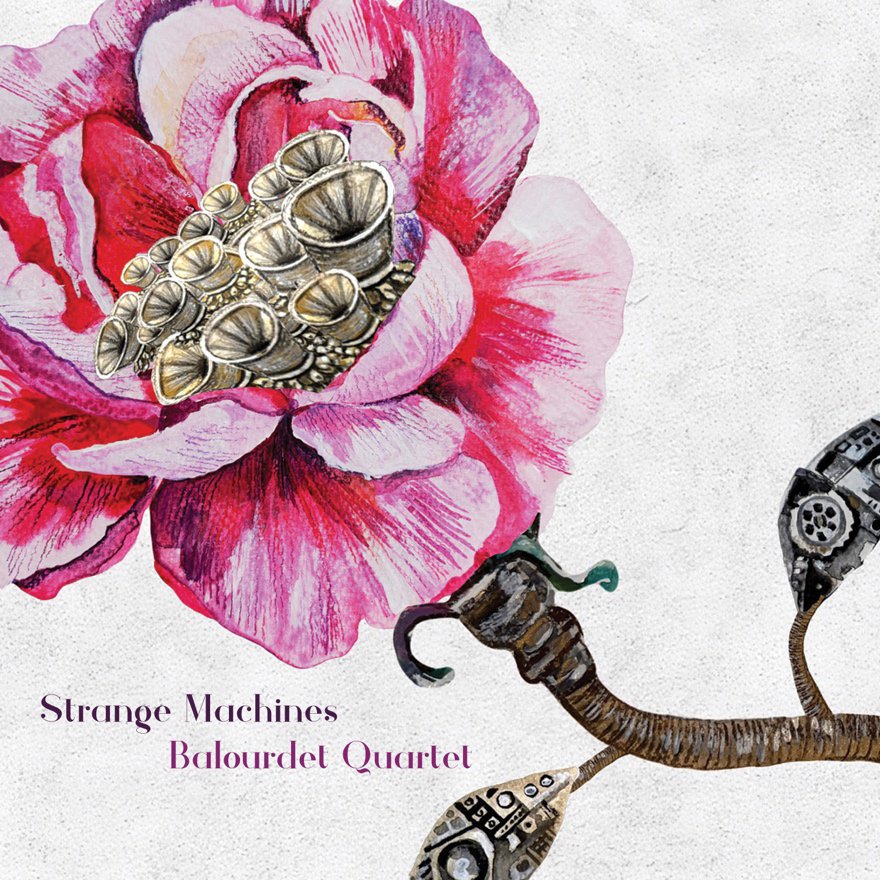 stretches across nearly six centuries of music while exploring artificial intelligence, memory, machinery, mortality and the future of the string quartet. The titular piece, Strange Machines, imagines three quirky musical automata. In Alberti Machine we encounter a steam-punk music box, its buttons, levers and dials adjusting a familiar accompanimental pattern until the machine breaks. Bach meets Rube in Goldberg Machine, a contraption that careens between variations in a musical chain reaction. And Mannheim Machine is a cliché-bot, an unhinged device that furiously spits out distorted musical tropes from the dawn of the symphony.
In a world where it feels like technology is tearing us apart, the Balourdet Quartet illustrates how it can bring us together. After commissioning Strange Machines through the Chamber Music America’s Classical Commissioning Grant, and concurrently witnessing the exponential rise of AI (Artificial Intelligence), the Balourdet began to take on the intermingling of modern technology and the future of the string quartet. This recording spans nearly 600 years of music, ranging from the Renaissance to the present in new commissions, some of which utilize generative and predictive AI. If the string quartet itself is the ultimate superhuman device, this album explores extending this device beyond its traditional limitations through new dimensions of language and emotion. Strange Machines traces a continuous thread through human history: our enduring desire to build tools that help us better understand ourselves. In the end, the strangest machine on this album may not be artificial intelligence at all. It may be the string quartet itself—four individuals becoming something greater than the sum of their parts, transforming wood, wire, and human imagination into meaning.
