

Musiqa Awarded Second “Adventurous Programming” Award from CMA/ASCAP
- On December 16, 2015
- By alzand@rice.edu
- In Musiqa, News
 0
0


Musiqa has just been honored with an “Adventurous Programming” Award from Chamber Music America and ASCAP, its second such award in three years. Three ensembles and four presenters were selected to receive 2016 CMA/ASCAP Awards, which will be presented at the Chamber Music America National Conference on Sunday, January 10, 2016 at the Westin New York at Times Square in New York City. Cia Toscanini, vice president of concert music, American Society of Composers, Authors and Publishers (ASCAP), will present the awards. Established jointly by Chamber Music America and ASCAP, the annual awards recognize U.S.-based professional ensembles and presenters for distinctive programming of music composed within the past 25 years. The recipients, chosen by an independent panel of classical and jazz chamber music professionals, were evaluated on the basis of their programming and innovations in attracting audiences to performances of new music. Musiqa
SOLI concert in San Antonio features Swimmy
- On November 05, 2015
- By alzand@rice.edu
- In Musiqa, News, Reviews/Press
- 0
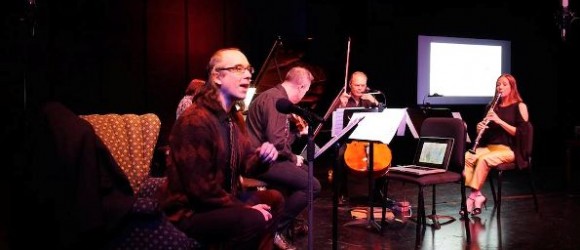
Classical Voice North America (Journal of the Music Critics Association of North America) reviews SOLI Chamber Ensemble’s October 5th opening concert, which featured a program of works by Pierre Jalbert, Anthony Brant and my piece Swimmy, narrated by Texas Public Radio’s Nathan Cone.
Al-Zand deftly embodies in music the spirit, delicacy, and subtle colors of Lionni’s illustrations (projected on a screen for this performance). Especially delicious are the rhythmically cockeyed walk of a lobster and the serpentine gliding of an eel “whose tail was almost too far away to remember.”

Tagoriana CD reviewed in Italy
- On October 21, 2015
- By alzand@rice.edu
- In News, Reviews/Press
- 0

The September issue of La Tenda, a monthly cultural magazine based in Teramo, Italy, reviewed Tagoriana, a CD on Albany Records that includes my Tagore Love Songs. The recording features mezzo-soprano Aidan Soder, baritone Paul Busselberg and pianist Calogero Di Liberto.
…Al-Zand chiude la Tagoriana con la sua giovanile immediatezza e la sua inventiva melodica che non rinuncia alla tradizione liederistica e si compenetra perfettamente con i testi da lui scelti.
…Al-Zand closes out Tagoriana with a youthful immediacy and melodic invention that does not reject the lieder tradition and perfectly interprets his chosen texts.
SOLI perform Swimmy on Musiqa’s Opening Night at MATCH
- On October 12, 2015
- By alzand@rice.edu
- In Musiqa, News, Reviews/Press
- 0
 San Antonio’s SOLI Chamber Ensemble performs Swimmy on Musiqa‘s October 10th concert at the new Midtown Arts and Theatre Center (MATCH). A preview feature appears in the Houston Chronicle. The narrator will be actor Seán Patrick Judge. Other pieces on the program include works by Anthony Brandt, Pierre Jalbert, Marcus Maroney and Carl Schimmel. Performances of this same program will also take place in San Antonio on October 6th and 7th with narrator Nathan Cone.
New CD by Museaux Trio
- On August 12, 2015
- By alzand@rice.edu
- In News
- 0
The Museaux Trio (Syndey Carlson, flute; Denise Fujikawa, harp; and Brian Quincey, viola) have just released their debut CD, which includes a recording of Studies in Nature, a work commissioned for them. The piece is inspired by the illustrations of biologist and artist Ernst Haeckel (1834–1919). His seminal Kunstformen der Natur (1899–1904) features beautiful, elegant renderings of newly discovered sea organisms. A species of radiolaria appears on the CD cover (below). The recording is released on Albany Records and is available for download at iTunes and Amazon.

